Tsum Valley Trek in May
6 Nov 2026 Mr. Kumar BK
May would be an ideal month for the Tsum Valley trek. Warm temperatures, blooming rhododendrons at the lower parts of the trail, greenery in the valley, and few people on the trail compared to other months are among reasons May can be an ideal time for the trek. In return, it means dealing with heat and humid weather in the low part of the river gorge, hazy mountains compared to those during the fall season and some rainfall during the late part of the month.
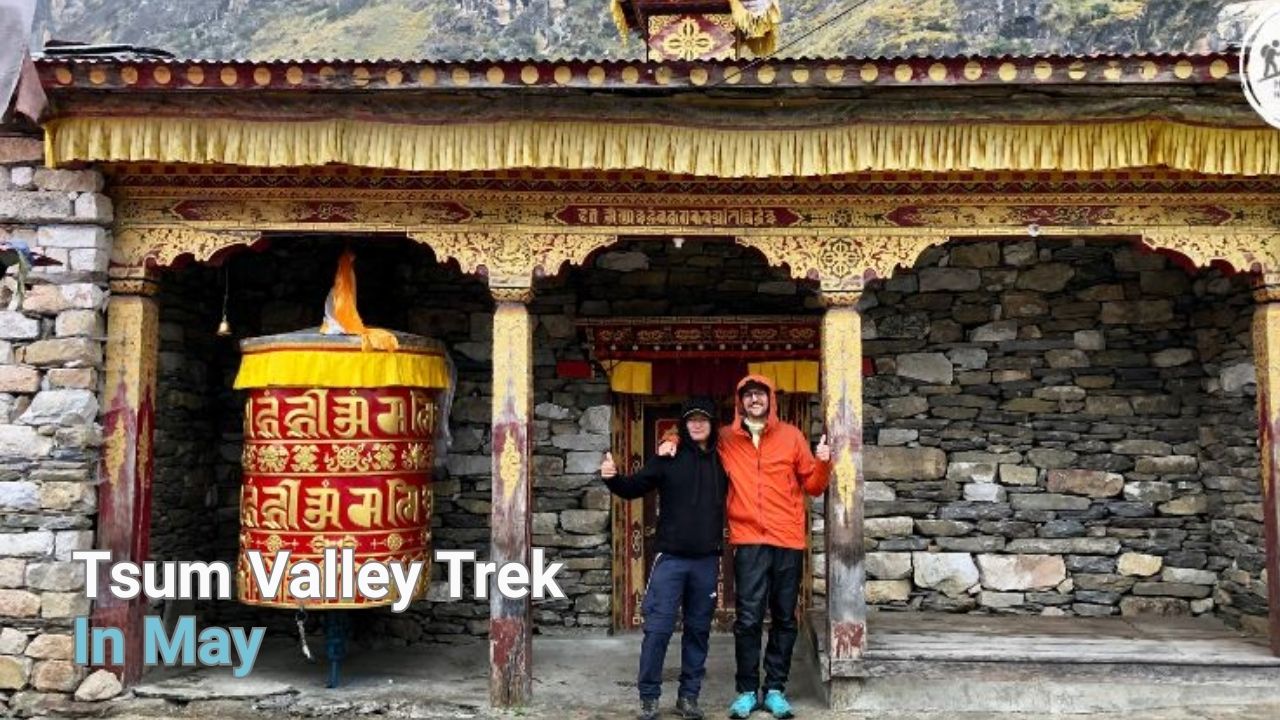
It is what you picture beforehand. Colorful prayer flags dancing in the wind above a village made of stones. Monks going about their business while moving past mani walls that seem endless. Snowy peaks above the valleys and Tibet beyond the ridge.
It comes when you read that autumn is “the best time” and question whether choosing May was your mistake. It is far from being true. Your Tsum Valley trek in May will not only be a different experience from what you will get from October but probably a more favorable one too.
However, there is more to May. The first couple of days will be hot. Late May will be rainy. The permit regulations will befuddle just about everyone. This guide covers everything, including the truth, from people who trek through the valley year after year.
Want some dates and a price quote for your group? Visit our Tsum Valley Trek page and contact us today! We will help you organize your trip in May.
Is May a Good Time for the Tsum Valley Trek?
Absolutely, with one tiny hitch. The two principal seasons for trekking in Nepal are spring (March to May) and fall (September to November), both of which make sense due to the lack of monsoons that ensure dry terrain and open roads.

The choice clearly lies with the latter season in terms of mountain scenery. Mountains become especially crisp after being washed by monsoon rains. However, fall does not score high on other factors important in the Tsum Valley.
| Month | Days | Nights at Nile (3,500 m) | Mountain views | Rain risk | Trekkers on trail |
|---|---|---|---|---|---|
| Tsum Valley in April | Mild | Cold, near freezing | Clear mornings | Low | Few |
| May | Warm, hot low down | Cool, just above freezing | Hazy by afternoon | Low early, higher late May | Very few |
| October | Mild | Cold | Clearest of the year | Very low | Most of the year |
Why isn’t haze a problem here? As the Tsum is not a one viewpoint hike as opposed to Gokyo Ri and Kala Patthar, the people, monasteries, and the Tsum valley itself are your purpose of coming. May is a month in which you’ll enjoy the best views of green fields with blooming trees of barley and no haze.
Therefore, if you prefer tranquility of walks through villages to taking photographs of peaks, you can visit Tsum in May.
Tsum Valley Weather in May
May weather in Tsum changes with two things. The date, and how high you are. Get both right and the month works in your favour.
Early May vs Late May to Tsum Valley
Weeks one and two are just right for trekking. Mornings are sunny, afternoons cloudy sometimes, and rainy weather is very unusual. You can have a cup of butter tea and enjoy the sunshine while sitting outside your lodge in Chhekampar at 5pm.
From about 20th May, the monsoon begins its journey north from the plains. The average starting date for Nepal’s monsoon season is mid-June, although in some years, it comes in late May. This results in more frequent rain showers in the afternoons, particularly in the lower section of the trekking trail.
Rain, Haze and the Lower Budhi Gandaki
This is the most omitted bit of information in most blog posts. You begin your trip from Machha Khola at an altitude of only 869 m. Lower compared to Kathmandu city. The month of May finds Budhi Gandaki gorge hot and humid with dust from the dirt track road in the morning by 10 am.
The trekking route now goes in an eastern direction through Lokpa and gets you to the beginning of the Tsum valley area. The weather changes abruptly. The higher altitude Tsum Valley area receives far lesser precipitation compared to the river gorge because of its proximity to the Tibetan Plateau.
Two different kinds of climate in one single hike. Hot and humid during first two days followed by cool and dry.
Temperatures by Village in May Tsum Valley Trek
These are typical May ranges our guides see on the trail. Use them to pack, not as a guarantee.
| Village | Altitude | Daytime | Night |
|---|---|---|---|
| Machha Khola | 869 m | 26 to 32°C | 18 to 22°C |
| Jagat | 1,400 m | 24 to 30°C | 16 to 20°C |
| Lokpa | 2,240 m | 18 to 24°C | 10 to 14°C |
| Chumling | 2,386 m | 18 to 23°C | 9 to 13°C |
| Chhekampar | 3,031 m | 14 to 20°C | 4 to 8°C |
| Nile | 3,500 m | 10 to 16°C | 0 to 5°C |
| Mu Gompa | 3,700 m | 8 to 14°C | -2 to 3°C |
Check the difference between the first and last row. That’s a difference of more than 30 degrees Celsius in less than a week. That’s why layers of clothes work better than one thick coat.
On a positive note, even the coldest May nights in Nile aren’t harsh when compared to those in fall or winter. With a warm sleeping bag and soup in your stomach, you will have no trouble getting sleep.
Saga Dawa and Other Festivals in May
But Saga Dawa is the most important one. The birth, enlightenment, and death of Buddha are celebrated by Tibetan Buddhists on the full moon day of the fourth Tibetan month. This is generally in May or early June, which means that a trek in May may coincide with it.
In a place where all people are Buddhist, it is definitely not an event for tourists. Families travel to monasteries, butter lamps are lit, and one can hear long horns, cymbals, and drums during the prayers. People also refrain from eating meat and performing good deeds throughout the month.
How to time your Tsum Valley trek around it?
However, the actual date of the festival is determined by the lunar cycle and not by the Gregorian calendar. Therefore, if you decide when to come, we will take into consideration your dates and the position of the full moon. It will be easy for us to change the starting date of the trip by one or two days to coincide it with the full moon in Mu Gompa or Rachen Gompa.
What if your dates don’t match?
You shouldn’t be concerned about this. The daily routine in Tsum is like a festival itself. There will still be morning chanting at Rachen Gompa, prayer wheel spinning in every village, and tea with the nuns who reside there throughout the year.
Rhododendrons, Wildlife and the Green Valley During Tsum Valley Trek
May is the time of awakening of the valley. Rhododendron blooms in forests around Lokpa and Philim with flowers of crimson red and magenta among the thick foliage of dark green of pine forests. Upwards, barley and potato patches shine with a rich green color. You will be able to meet local families working their farms with their bare hands.
Watch for wild animals as well. Blue sheep graze hills around Nile; Himalayan monal – Nepal’s national bird famous with iridescent colored feathers can always be observed around the trail at sunrise. Yaks, naks and chauri – yak-cow crossbreed go for the grass of summer pastures.
When else will you have such opportunity to walk by the fields that look the same as hundred years ago with peaks covered with snow of the Ganesh Himal on one side and Tibet on another one? This is the true essence of Tsum in May.
Respecting Tsum Valley Customs
Tsum is a sacred valley, called a beyul or hidden refuge in Tibetan Buddhism. People here have lived by a strong tradition of non-violence for generations. Visitors who follow a few simple rules get a much warmer welcome.
- Don’t carry meat or animal products into the upper valley or onto monastery grounds. Our lodges serve vegetarian food up there.
- Walk clockwise around chortens, mani walls and prayer wheels, keeping them on your right.
- Ask before taking photos of people, monks and nuns, and inside monasteries.
- Remove your hat and shoes when entering a monastery prayer hall.
- Dress modestly, with shoulders and knees covered near the gompas.
It sounds like a lot. It isn’t. Your guide will remind you at each place, and locals really do notice when you make the effort.
Our 12-Day Tsum Valley Trek Route in May
Our route goes up the Budhi Gandaki river, turns into the Tsum Valley at Lokpa, and climbs to Nile and Mu Gompa near the Tibetan border. You come back down through Rachen Gompa and the lower valley.
| Day | Route | End altitude | Walking time |
|---|---|---|---|
| 0 | Arrive in Kathmandu | 1,350 m | Airport transfer |
| 1 | Drive Kathmandu to Machha Khola via Arughat | 869 m | 8 to 9 hrs drive |
| 2 | Machha Khola to Jagat | 1,400 m | 6 to 7 hrs |
| 3 | Jagat to Lokpa | 2,240 m | 5 to 6 hrs |
| 4 | Lokpa to Chumling | 2,386 m | 4 to 5 hrs |
| 5 | Chumling to Chhekampar | 3,031 m | 4 to 5 hrs |
| 6 | Chhekampar to Nile via Lamagaon and Chhule | 3,500 m | 4 to 5 hrs |
| 7 | Visit Mu Gompa and return to Nile | 3,700 m high point | 3 to 4 hrs |
| 8 | Nile to Rachen Gompa | 3,240 m | 3 to 4 hrs |
| 9 | Rachen Gompa to Dumje | 2,460 m | 3 to 4 hrs |
| 10 | Dumje to Philim | 1,570 m | 6 to 7 hrs |
| 11 | Philim to Machha Khola | 869 m | 6 to 7 hrs |
| 12 | Drive back to Kathmandu | 1,350 m | 9 to 10 hrs drive |
It is on days 2 and 3 that May gets heated. Set out by 7 am to ensure that all your uphill climbs are completed in cool conditions before the day becomes very hot. Jagat is where your permits are checked, so it would be wise to have your passport copy readily accessible.
It is on day 5 when you head to Chhekampar that Tsum really starts to open up to you. You will start encountering wider valleys, long mani walls lining the path, and the villages will consist of flat-roofed stone structures, with firewood laid on the roof. It is impossible not to slow down here unintentionally.
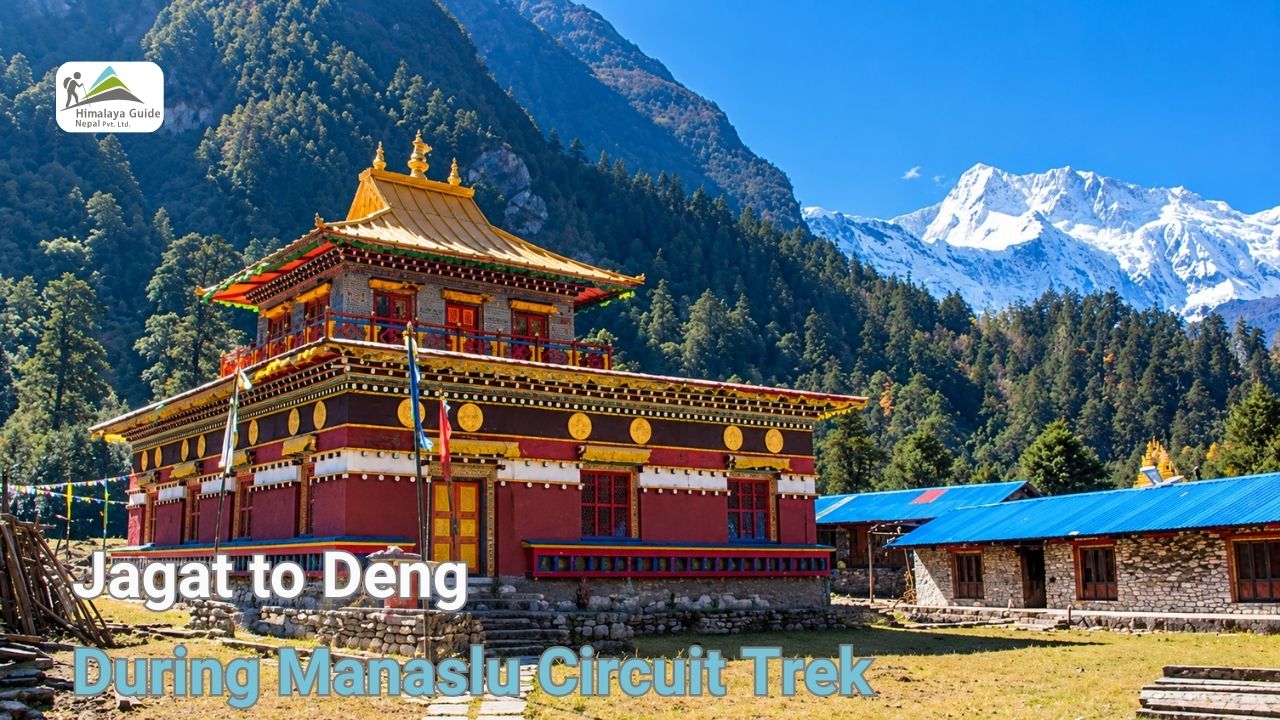
On day 7, you will reach Mu Gompa. This is the most impressive site on your journey. It is the largest monastery built on 3,700 m above sea level and was built in the late 1800s. If you are lucky enough to encounter a clear day in May, you will be able to see the peaks near the border with Tibet from there.
Getting to Machha Khola in May During Tsum Valley Trek
There is no flight option in this trek either. One arrives at the starting point by road and it is quite a long journey. The road distance from Kathmandu to Machha Khola via Dhading and Arughat takes around 8 to 9 hours by bus.
The weather in early May will be dry and dusty. The last stretch of the road after Arughat is quite bumpy and hence one should be prepared for that and also dust in the air and a pack of snacks for the journey.
May late is more problematic because the pre-monsoon rains might soften the road and cause some small landslides on the lower part of the road. That is the reason we advise our clients to have an extra day in Kathmandu after the trek, especially if one travels after 20 May.
Permits and Cost for a May Tsum Valley Trek
Tsum Valley is a restricted area. This implies that you cannot trek in this area solo or using a basic permit but require a Restricted Area Permit, Manaslu Conservation Area Permit, and a local fee. Additionally, a guide and agency are required legally.
This sounds difficult, right? Not for you! We have all your permits in the package, and we get them done for you before you leave from Kathmandu. There is one benefit of trekking in spring season too. Restricted area permits in Nepal cost less in seasons other than autumn.
Here is our current price per person.
| Group size | Price per person |
|---|---|
| 1 person | USD 945 |
| 2 to 4 people | USD 825 |
| 5 to 7 people | USD 677 |
| 8 to 10 people | USD 650 |
| 11 or more | USD 640 |
The cost covers your transportation to and from the mountains by bus, your guide service, lodging arrangements, three meals per day during the trek, two nights at a hotel in Kathmandu, and a down jacket and sleeping bag to use. Allocate more money for drinking, showers, electricity charges, insurance, and tips. Trekking in this region costs about USD 10 to 20 a day.
Tsum Valley Trek Teahouses and Food in May
Tsum teahouses are more primitive compared to those found on the Annapurna and Everest trails. This is what makes the trip special. Chumling, Chhekampar and Nile have the best teahouses with clean twin beds and cozy kitchens.
Lokpa has only one teahouse and thus during peak season your guide may make reservations beforehand. The teahouses in Mu Gompa and Rachen Gompa are simple monasteries. Hot water showers are provided at almost all stops, although you may have to pay a small fee.
The food is local and authentic. You will be served dal bhat with fresh vegetables, potatoes that grow in the surrounding fields, tsampa porridge made from roasted barley flour and Tibetan bread with honey. Meals in the upper valley are vegetarian, which corresponds to the local tradition. And there is nothing like hot noodle soup served near the kitchen fire after a chilly night in Nile.
How Hard Is the Tsum Valley Trek?
Talking about the Tsum Valley Trek difficulty, it is not a difficult trek, with no steep mountain passes and no technically challenging areas. The usual trek involves walking from 4 to 6 hours and 10 to 18 kilometers per day.
What makes it difficult? First of all, long climbs from the river gorge in the second and third days of the trek; secondly, heat in the valley in May; thirdly, the ascent to Mu Gompa at 3,700 meters of elevation. Though the altitude is not as high as for EBC, there could be a headache above 3,000 meters.
Can beginners do it?
Indeed, but only if you prepare yourself. A properly trained beginner can accomplish this in 6 to 8 weeks. Walk for an hour almost every day, use the stairs, and have some long weekend hikes with a pack on your back. That is all.
A May tip most people learn too late
Heat drains you faster than altitude on this trek. Drink 3 litres of water a day, eat salty snacks, and walk slowly in the gorge. Your guide sets a steady pace for exactly this reason.
What to Pack for Tsum Valley in May
Tsum Valley packing is packing for summer and winter at the same time in May. So we will rent you a down jacket, a sleeping bag and a duffel bag, so no need to take them from home.
Starting with light clothing for Gorge area. Two quick-dry t-shirts, light trekking pants, a sunhat, SPF 50 sunblock lotion. Add insect repellant as well because there will be insects in the lower forest in May.
On top of that add warmer clothes for Upper Valley. A fleece, a warm cap, light gloves and thermal underwear for night stays in Nile. Also take along a light rain jacket or a poncho especially during late May. Don’t forget your broken-in boots, a headlamp, water purification tablets and a reusable water bottle. Stores are quite scarce in this area.
Tsum Valley Trek in May FAQs
Q: Is May a good month for the Tsum Valley trek?
A: Yes. May gives you warm days, green fields, blooming rhododendrons and quiet trails. The views are a little hazier than autumn, but the cultural side of Tsum makes up for it.
Q: Does it rain in Tsum Valley in May?
A: Early and mid-May are mostly dry. Late May can bring afternoon showers, mostly on the lower river section. The upper valley usually stays drier.
Q: When is Saga Dawa in 2027?
A: Saga Dawa falls on the full moon of the fourth Tibetan month, usually in May or early June. Tell us your dates and we’ll plan around it.
Q: Can I trek Tsum Valley solo?
A: You can’t trek here without a licensed guide, because Tsum is a restricted area. If you’re travelling alone, talk to us and we’ll find the best option.
Q: Can I combine Tsum Valley with the Manaslu Circuit in May?
A: Yes. You can add the Manaslu Circuit and cross Larkya La pass after visiting Tsum. It’s a longer trek of around 19 days. Ask our team for the combined itinerary.

Kumar BK is a young and energetic government-registered trekking guide in the Nepal tourism industry, has been to Everest, Annapurna, Manaslu, Langtang, Mustang, and Ruby Valley. He is an honest...