Manaslu Circuit Trek Altitude: What I Tell Every Trekker Before We Leave Kathmandu
7 Jul 2026 Dinesh Gurung
| By Dinesh Gurung, Licensed Trekking Guide (Lic. No. 10937, guiding since 2013) |
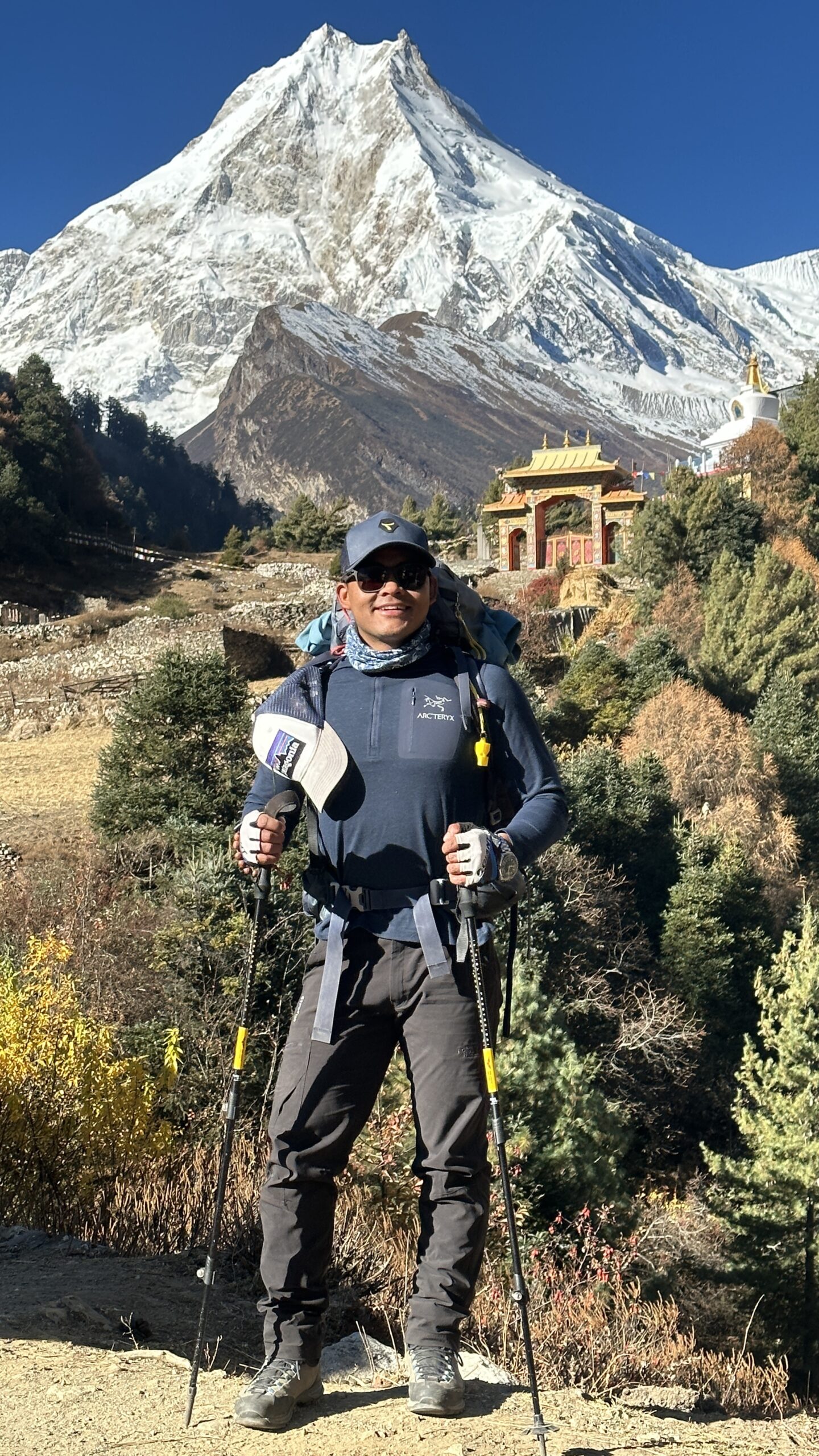
My name is Dinesh Gurung. I received my government trekking license in 2013 and I have been guiding on the Manaslu Circuit ever since. In those years, I have crossed Larkya La Pass more than 40 times. In October sunshine, in November snow, in pre-dawn darkness at 3 AM with headlamps pointing up at nothing but cold rock and thin air.
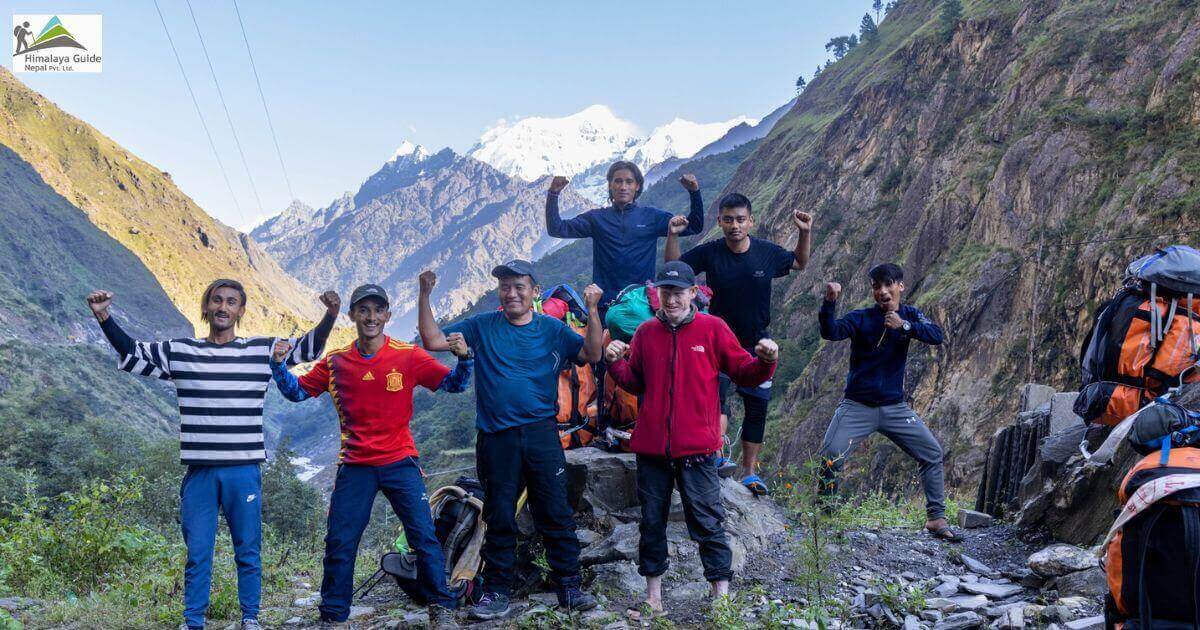
And in all those years, one pattern holds in all group. People prepare for the wrong things. They train hard, buy good gear, and research teahouses. Then they arrive in Kathmandu with almost no real understanding of what altitude does to the body above 3,500 metres on a high altitude trek in Nepal.
This article is what I tell every client before we start the Manaslu Circuit Trek about altitude sickness. How to stop altitude sickness before it starts. What to carry. If you read this carefully, you will be far better prepared than most hikers who show up without having thought about it.
| Want a personalised itinerary with proper acclimatisation days already sorted? Talk to our team today and we will get it done. |
Manaslu Circuit Altitude Profile Overview
Before any client takes a single step on the Manaslu Circuit Trek, I sit with them and go through the altitude profile. Many of them are surprised. The Manaslu trek elevation starts modestly, but it gains height faster than most trails.
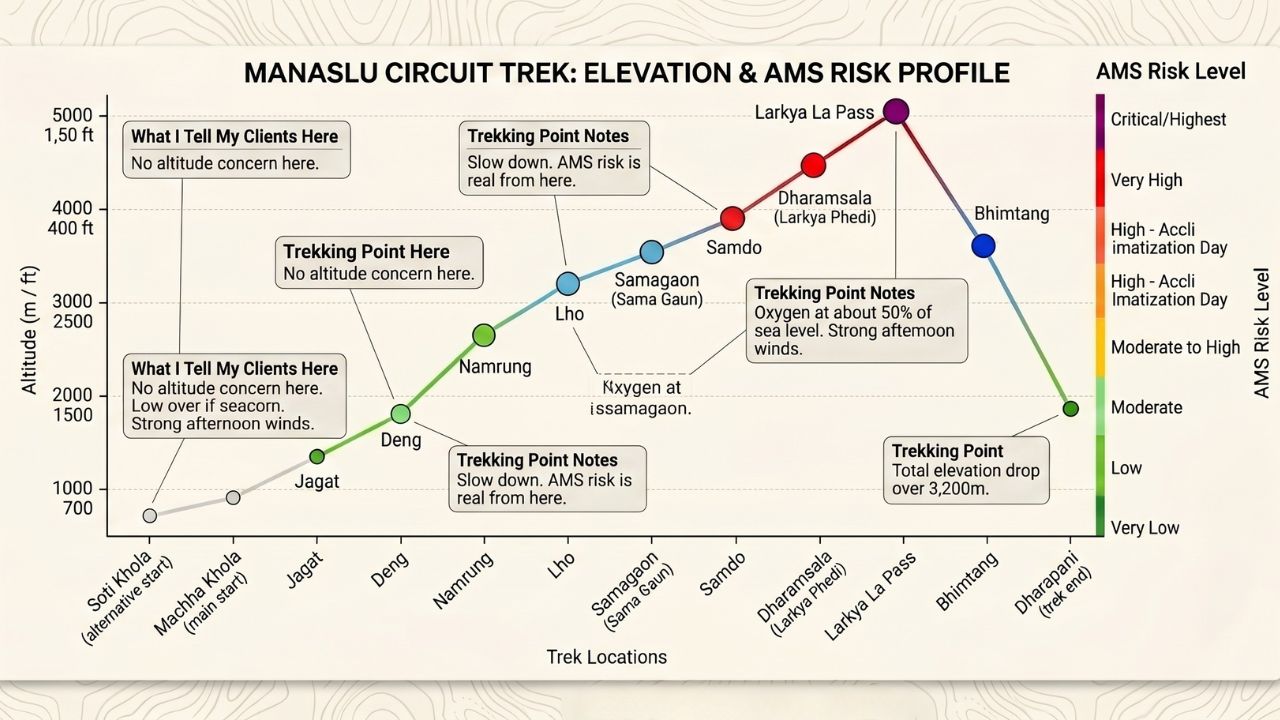
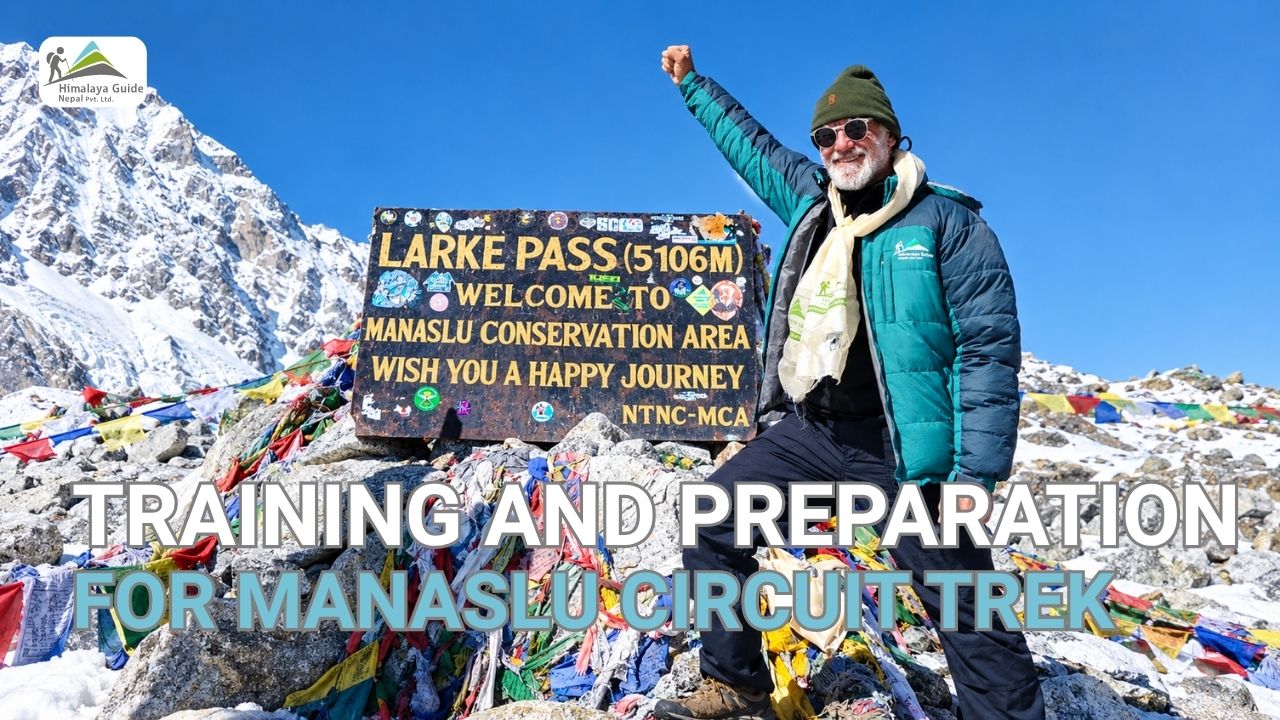
If you begin from Soti Khola, you start at 710 metres (2,329 ft). From Machha Khola, the more common start point, it is around 900 metres (2,952 ft). The trek ends at Dharapani at 1,860 metres (6,102 ft). But in between, you push all the way to Larkya La Pass at 5,106 metres (16,752 ft). That is a total elevation gain of over 4,300 metres from the valley floor to the top of the pass. Below is the same table I walk my clients through before we leave.
| Location | Altitude (m / ft) | AMS Risk Level | What I Tell My Clients Here |
| Soti Khola (alternative start) | 710 m / 2,329 ft | Very Low | Lower starting point. Warm, forested trail. No altitude concern here at all. |
| Machha Khola (main start) | 900 m / 2,952 ft | Very Low | Most groups begin here. Good place to settle into the pace and drink water. |
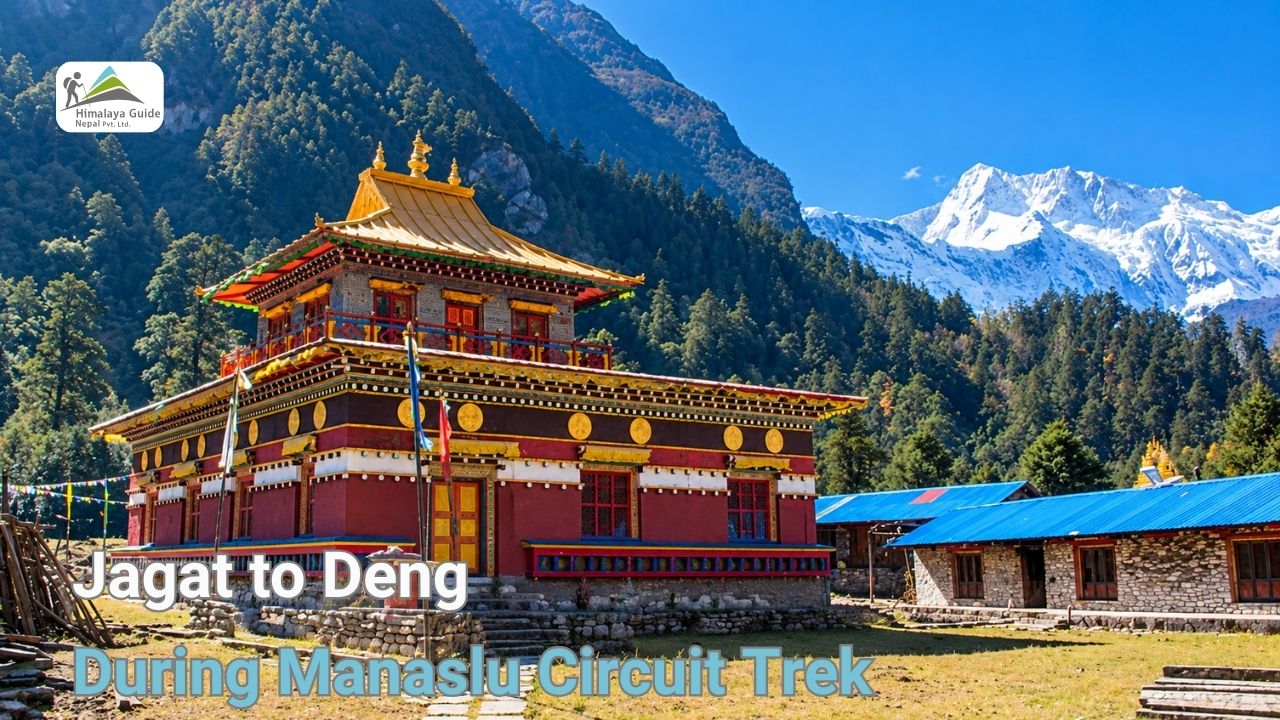
| Jagat | 1,340 m / 4,396 ft | Very Low | Manaslu Conservation Area checkpoint. Build your rhythm. Watch your hydration. |
| Deng | 1,804 m / 5,918 ft | Low | Still very safe. Long days in the heat. This is the time to find your pace. |
| Namrung | 2,630 m / 8,629 ft | Moderate | First signs of altitude. Tibetan culture begins. Monitor for mild headaches from here. |
| Lho | 3,180 m / 10,433 ft | Moderate to High | First clear view of Mt. Manaslu (8,163 m). Slow down. AMS risk is real from here. |
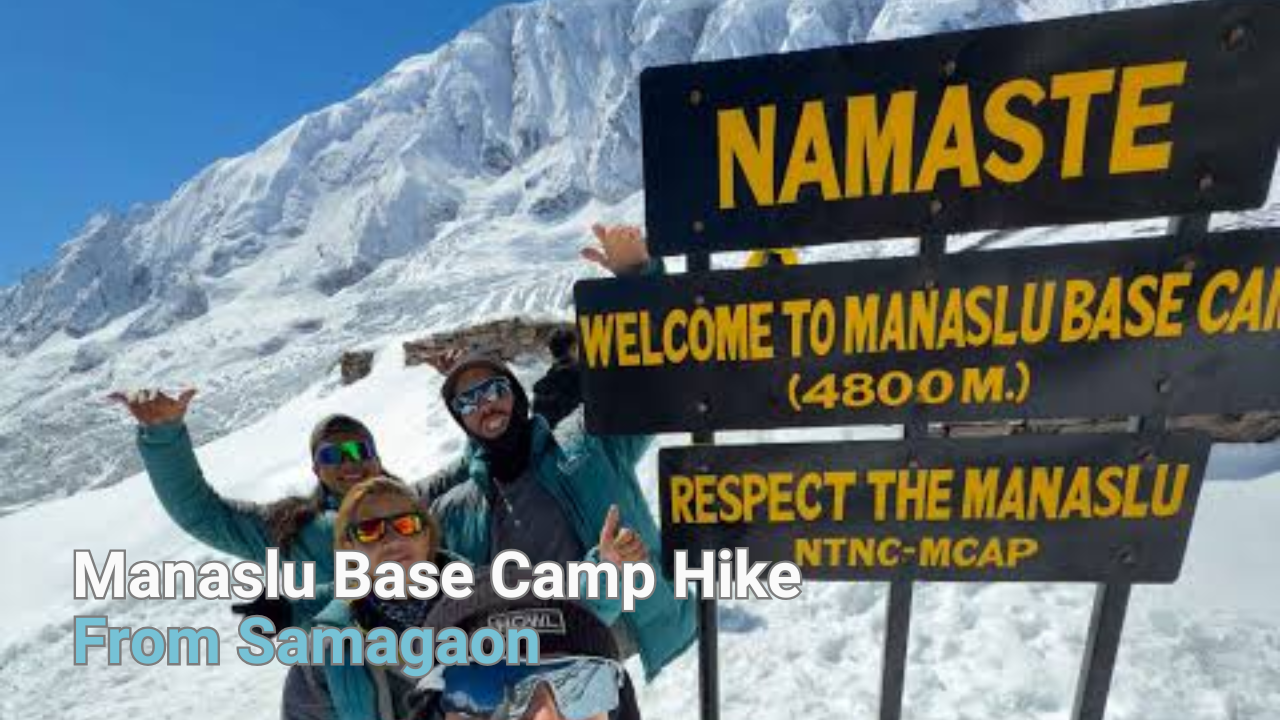
| Samagaon (Sama Gaun) | 3,530 m / 11,581 ft | High – Acclimatisation Day | Key rest stop. Active hike to Birendra Lake or Manaslu Base Camp (4,800 m / 15,748 ft). |
| Samdo | 3,875 m / 12,713 ft | High – Acclimatisation Day | Last village before the pass. Skipping this night is the most common cause of AMS at Larkya La. |
| Dharamsala (Larkya Phedi) | 4,460 m / 14,632 ft | Very High | High camp. Highest sleeping altitude on the entire trek. Start the pass at 3-4 AM. |
| Larkya La Pass | 5,106 m / 16,752 ft | Critical – Highest Point | Peak Manaslu Circuit Trek altitude. Oxygen at about 50% of sea level. Strong afternoon winds. |
| Bhimtang | 3,590 m / 11,778 ft | Descent – Recovery | AMS symptoms ease as oxygen levels return. Rest fully here. You earned it. |
| Dharapani (trek end) | 1,860 m / 6,102 ft | Very Low | Trek finishes here. Total elevation drop from Larkya La is over 3,200 metres. |
Four Zones / Profile During Manaslu Circuit Trek
When I explain altitude to my clients, I break the route into four zones. Each one demands something different from the body, and each one needs a different level of attention from me as a guide.
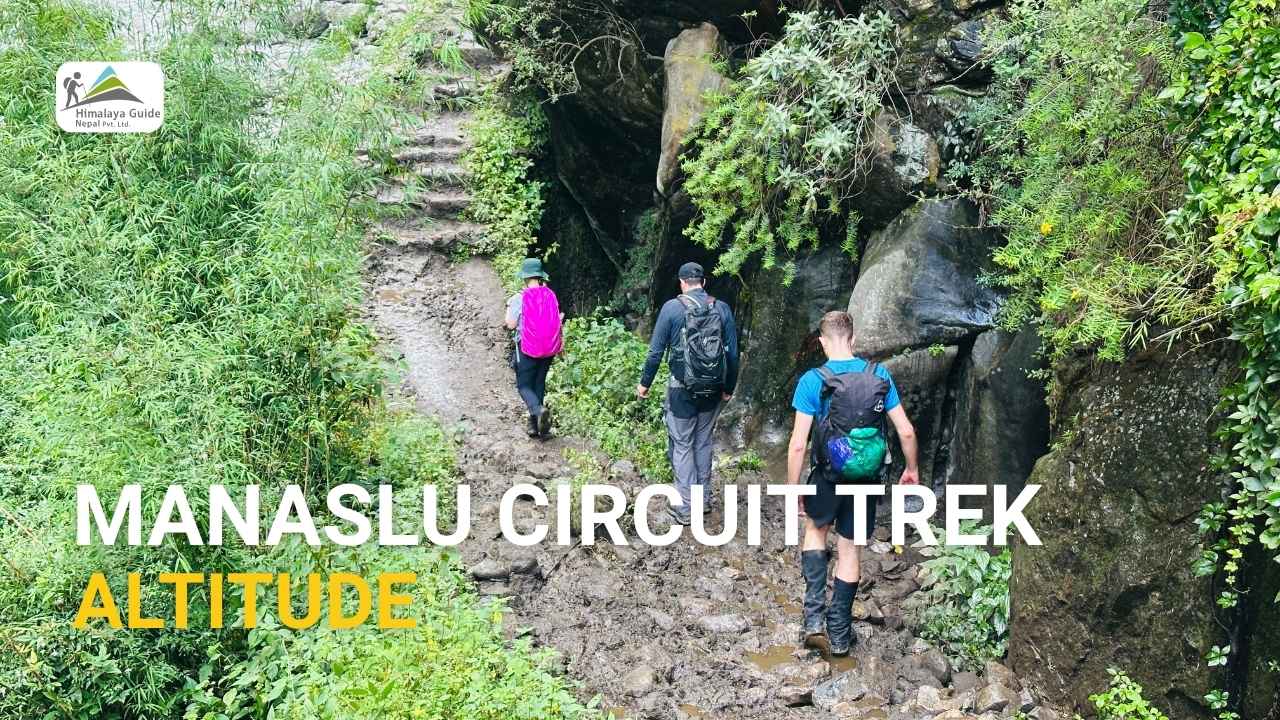
Zone 1 runs from the trailhead up to around 2,500 metres, through Machha Khola or Soti Khola, Jagat, and Deng along the lower Budhi Gandaki valley. True altitude sickness is rare in this stretch. The heat can be real, and the days are long. I use these early stages to observe each client. How do they pace themselves? Do they drink enough water? Are they listening to their body or pushing past the signals? These early habits tell me a lot about what to expect higher on the route.
Zone 2 covers 2,500 to around 3,500 metres, through Namrung, then Lho at 3,180 metres (10,433 ft), and up to Samagaon. Lho is where my clients often stop walking mid-stride and just stand there, staring up at Mt. Manaslu (8,163 m) rising above the valley for the first time. I let them have that moment. It is a powerful one. Then I ask them to drink water and keep pace. And this is exactly where altitude sickness on the Manaslu Circuit becomes a genuine concern. Headaches that stay after resting are a flag, not a footnote.
Zone 3 sits between 3,500 and 4,500 metres, covering Samagaon, Samdo, and Dharamsala. This is the zone where the Manaslu Circuit altitude challenge is most demanding. The stretch from Samagaon (3,530m) to Larkya La (5,106m) is the most critical section of the entire route. Two full rest days are built into this zone. I have never skipped them. I never will.
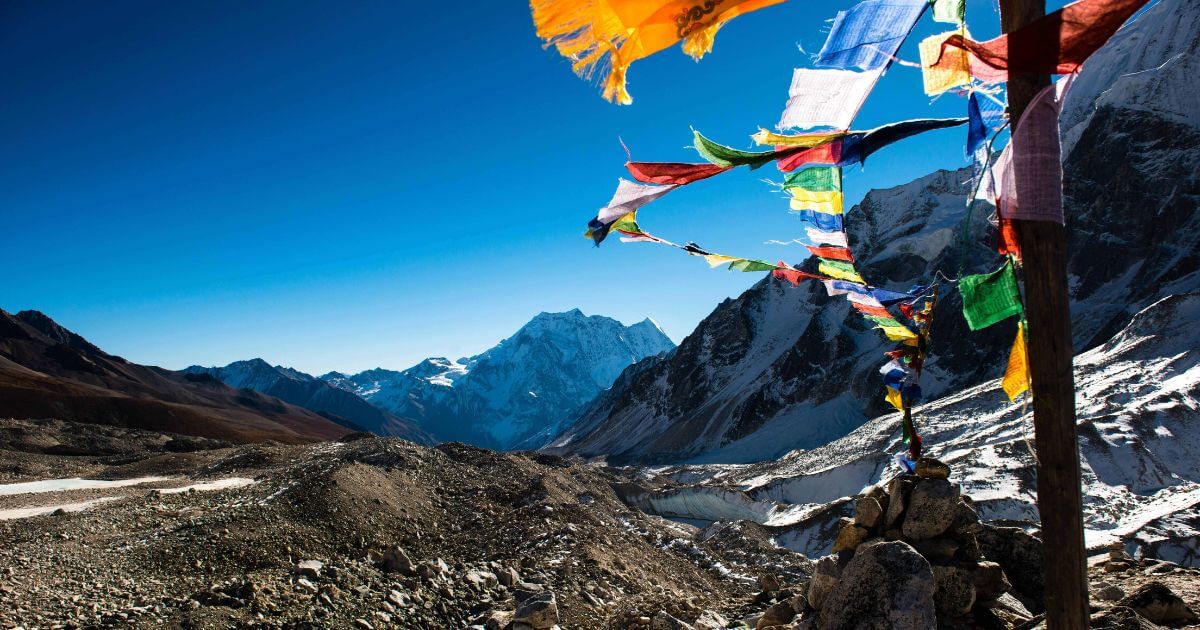
Zone 4 is above 4,500 metres, from Dharamsala up to Larkya La Pass at 5,106 metres (16,752 ft). Oxygen levels at this height run at roughly half of what you breathe at sea level. We start the crossing at 3 AM or 4 AM to beat the strong afternoon winds that can make the pass unsafe. In my years of guiding, I have crossed Larkya La in sunshine, in snow, in silence. What I know is that everything done in the days before this one, every rest taken, every litre drunk, every symptom reported, shows up clearly at that pass.
Altitude Sickness Does Not Care How Fit You Are
This is the thing I say at every pre-trek briefing. Altitude sickness on the Manaslu Circuit Trek happens regardless of fitness levels. I have told this to hundreds of clients and still get the same look of disbelief from runners and athletes sitting across from me.
Above 3,000 metres, the air thins. Atmospheric pressure drops. Each breath carries less oxygen than your body runs on at sea level. When you hike faster than the body can adjust, mountain sickness follows. It is not a weakness. It is not bad luck. It is a plain physical response to reduced oxygen levels.
On the Manaslu Circuit Trek, the elevation gain from Namrung to Samagaon over two days is close to 1,000 metres of sleeping altitude, which pushes right against the medical guideline of 300 to 500 metres per night. Without proper rest days, the body falls behind, and there is risk of having AMS.
I have guided marathon runners who suffered from AMS at Samagaon. And I have guided a 66-year-old retired teacher from Canada who crossed Larkya La without a single symptom because she rested one more day when she told me about every headache the moment it appeared. High altitude trekking in Nepal is not about who is strongest. It is about who listens.
AMS, HAPE, and HACE: The Three Types I Watch For on Every Trek
Acute Mountain Sickness is the most common on a high altitude trek like the Manaslu Circuit. The signs I watch for: a high altitude headache that worsens when the client moves, nausea, broken sleep, deeper-than-usual tiredness, and decreased appetite. AMS kicks in within 6 to 12 hours of reaching a new height. Mild AMS is workable. Brushing it off is not.
High Altitude Pulmonary Edema is when fluid gathers in the lungs and breathing becomes difficult even while sitting still. Signs include a cough that does not clear, breathlessness when lying flat, and a bubbling feeling in the chest. HAPE can develop 24 to 96 hours after significant altitude gain on the Manaslu Circuit and needs a fast descent. It is the leading cause of altitude-related death on Himalayan routes, and I treat every hint of it as urgent.
High Altitude Cerebral Edema affects the brain. Confusion, lost coordination, changed behaviour. A person with HACE often insists they are completely fine while struggling to walk in a straight line. In the Buddhist tradition I was raised in, we speak often of the importance of a clear mind. HACE takes that away. During the Manaslu Circuit Trek, if I see those signs in any client, descent happens without discussion.
Is It Just Tiredness or Altitude Sickness in Manaslu Trail?
On high altitude routes like the Manaslu Circuit trek. At the end of the day, you’re feeling tired after a long walk is completely normal. AMS has a different quality to it. Learning to tell them apart is one of the most useful skills a trekker can have on this route.
| Normal Trekking Tiredness | AMS Warning Signs – Come Find Me |
| Legs feel heavy at end of day | Headache that does not ease after 30 min rest and water |
| Sleep well and feel better by morning | Poor sleep and feeling worse after a full night’s rest |
| Appetite normal or slightly reduced | No appetite at all, or nausea and vomiting |
| Tired but alert and clear-headed | Confusion, dizziness, or feeling strangely detached |
| Short of breath only on steep uphill climbs | Breathless while sitting still or lying down |
| Tiredness that clears with 20 min of rest | Fatigue that does not lift with rest at all |
How I Keep My Clients Safe at High Altitude on the Manaslu Circuit
Preventing altitude sickness on the Manaslu Circuit Trek is the core of my job. The route, the pace, the rest days, the evening check-ins. All of it is built around one goal: getting every client to Larkya La Pass and back without a single serious incident.
Two Acclimation Days That Decide Everything
The acclimatisation day at Samagaon (3,530 m / 11,581 ft) and the rest day at Samdo (3,875 m / 12,713 ft) are the two most important days on the entire trek. Not the pass day. These two.
At Samagaon, I take clients on an active hike. Birendra Lake, Manaslu Base Camp at around 4,800 metres (15,748 ft), or Pungyen Gompa monastery depending on energy and weather. Pungyen Gompa is a working Tibetan Buddhist monastery and one of the most peaceful places I know on this entire route. The monks there have lived at this altitude their whole lives. Watching them move through morning prayers at 4,000 metres puts a lot into perspective. We go higher during the day and sleep lower at night. The body gets a dose of thin air, then repairs during sleep where oxygen levels are better. This is the climb-high, sleep-low rule, and it works.
At Samdo, we repeat the same process. Many budget operators drop this night to save time or money. I will not do that. That single sleeping altitude stop at 3,875 metres changes how the body handles Larkya La. I have seen the difference between trekkers who did this night and those who skipped it too many times to be casual about it.
One of my clients from Belgium, Elien G., summed up her experience this way: “When we experienced mild altitude symptoms, Dinesh managed the situation calmly and professionally. We also did stunning acclimatisation hikes to a lake and an old monastery with 360-degree mountain views.” That monastery is Pungyen Gompa. And the calm she mentions is not indifference. It is experience. It is knowing exactly what the situation is and what to do about it.
In my years of guiding the Manaslu Circuit Trek, I have managed altitude cases for over 150+ trekkers. I know what healthy adaptation looks like at each elevation point. And I can spot a problem building before most clients register any symptom at all.
What You Should Carry in Your Medical Kit for Altitude Sickness
See a doctor before you leave home. Some of these Manaslu trekking medications need a prescription. A few are not safe for people with heart, kidney, or lung conditions that high altitude conditions can worsen. Your doctor sorts that out before you pack.
| Medication | What It Treats | Dosage Guide | My Note on Each |
| Acetazolamide (Diamox) | Prevents and reduces AMS | 125-250 mg twice daily. Doctor approval needed. | Start one day before going above 3,000 m. Drink more water than usual when using it. |
| Ibuprofen or Paracetamol | High altitude headache from mild AMS | Follow label or doctor guidance. | Treats the symptom. Does not fix the problem. Never use to mask serious AMS. |
| Dexamethasone (Dex) | Emergency HACE treatment | 8 mg first dose, then 4 mg every 6 hrs. | Emergency only. Needs prescription. Buy before you leave home. |
| Nifedipine | Emergency HAPE treatment | 10 mg first dose, then as directed. | Emergency use only. Use with your guide’s knowledge. |
| Oral Rehydration Sachets (ORS) | Dehydration and electrolyte loss at altitude | One sachet per litre of water daily. | Use even when you feel well. Altitude pulls fluids from the body fast. |
| Azithromycin | Bacterial respiratory infection | 500 mg per day for 3 days. | Not for AMS. Use only when your guide suspects a bacterial infection. |
Garlic Soup and Ginger Tea Helps Acclimization
People always smile when I bring this up on the trail. I understand. But these are not tourist gimmicks.
Garlic soup is at every teahouse on the Manaslu Circuit route. In Nepali and Tibetan mountain culture, garlic has been used for centuries to support the body at altitude. It is thought to help thin the blood slightly and keep circulation working when oxygen levels drop. In my own Gurung tradition, what you eat at altitude has always been taken as seriously as medicine. Ginger tea settles the stomach and helps on rough mornings above 3,500 metres on the route.
Neither replaces acclimatisation or treatment for altitude-related illness. But on a Nepal high altitude trek like this one, above 3,000 metres, both are warm, real, and worth ordering at every teahouse stop. I order them myself, every single time.
If Someone Gets Sick on the Trail, Here Is Exactly What I Do
Let me walk you through this in practical terms. Not in abstract language. In the actual order it happens when you are trekking with me on the Manaslu Circuit.
Say you wake up in Samagaon with a splitting headache and no appetite. You come to me, which I ask every client to do from the very first day. I sit with you and go through the Lake Louise Score together. Headache, nausea, dizziness, sleep quality. If your score is low, the day’s plan changes. We rest. Water, same altitude, no upward movement that day.
If symptoms carry through the evening or worsen overnight, we drop 300 to 500 metres. That shift in sleeping altitude is usually enough to stop AMS from progressing further. The body responds quickly once oxygen levels start improving.
For HAPE or HACE, going down starts right away. Not after breakfast. Not after checking the weather. Right now. I carry emergency supplemental oxygen and pulse oximeters on every Manaslu Circuit Trek. We check blood oxygen saturation readings at every major altitude gain on the Manaslu Circuit. If a reading drops in a way that worries me, I act before the client even feels the full symptoms.
If descent on foot is not moving fast enough, I arrange a helicopter rescue in the Manaslu region. Air evacuation costs between USD 3,000 and USD 5,000 depending on weather and pickup location. Travel insurance that specifically covers high-altitude helicopter rescue is not optional on this route. Sort it before you fly to Nepal. Please.
Health posts in Namrung and Samagaon can handle basic medical attention along the Manaslu Circuit route. Above Samdo, there are no facilities. Your guide, your preparation, and your insurance are what you have.
Do not wait and hope it gets better on its own. AMS does not go away by pushing through it. And if I say we are going down, we are going down. That instruction does not come with a debate attached.
Traveller Who Faced Altitude Sickness Symptoms in Manaslu Circuit Trek
I want to share this before the question section below.
| Elien G. from Belgium finished the Manaslu Circuit Trek with me and picked up mild altitude sickness symptoms along the way. I adjusted the day’s plan, handled the situation without making it a drama for the rest of the group, and we carried on. She crossed Larkya La Pass on schedule with clear skies above her. She mentioned calm in her feedback. That word matters to me. In my years of guiding the Manaslu Circuit, I have seen every form of high altitude illness. A guide who panics is useless at altitude. A guide who reads the signs correctly and acts at the right moment is what keeps people safe. My elder brother built Himalaya Guide Nepal on exactly that principle. I carry it with me on every trek. Our team brings pulse oximeters on every trip on the Manaslu Circuit. We check blood oxygen saturation at every major altitude gain. If a reading starts to drop before a client registers any symptom, we are already talking about what comes next. Manaslu Circuit Trek altitude deserves real respect and real preparation. Come to it with the right plan, the right team, and a willingness to trust your guide. The Manaslu Circuit will give back something that very few places in the world can match. |

Mr. Dinesh Gurung, a native of the enchanting village of Sertung in the northern expanse of Dhading district, Nepal, embodies a unique blend of cultural heritage and academic pursuits. Born...